
How to Play Blackjack: Rules and Tips
Blackjack may initially appear complicated, but its basic format is easy to learn. This GCCans guide explains how to play blackjack, covering the core rules, card values, odds, payouts, table actions and more. Ready to understand the game before betting against the dealer? Read on.
The Basic Blackjack Rules - How to Play Blackjack
Blackjack is won by building a hand as close to 21 as possible without going over. The dealer is also trying to approach 21, so a hand nearer that total generally has the better chance of winning. Going beyond 21 means you bust and lose. When your total matches the dealer’s, the result is a draw known as a push.
Blackjack uses several decks of cards; six is the most common number, although the total can range anywhere between one and eight. After you place your original wager in the table's betting box, the dealer deals two cards initially to each player and himself. All of those cards are dealt face-up. Each player combines the face values of their cards and decides whether to request additional cards to move as close to 21 as possible. Players may keep requesting further cards until they choose to keep their score, reach 21, or go beyond 21 and bust.
At a brick-and-mortar casino, you may share a table with up to six other players while the dealer sits opposite you. Everyone is competing with the dealer, not with one another. Turns proceed from left to right, followed by the dealer’s turn. A winning hand normally pays 1:1: your original stake is returned along with an equal amount in winnings. For example, a $50 winning stake returns the original stake plus $50 in winnings.
The main exception is a “blackjack”—a two-card 21 made with an Ace and a ten or picture card. The most common payout ratio for this hand is 3:2, and the table should display that ratio before you begin.
A typical table may set the minimum bet at $5 and the maximum at $500. Limits differ according to the casino and table, but these are common examples.
The Odds and House Edge of the Game of Blackjack
The odds of winning in blackjack are near 50%, with 46-48% often quoted. The figure is not an exact 50/50 because the player acts first. That creates a chance of busting by exceeding the maximum before the dealer has to play.
With basic blackjack strategy, the house edge is stated as 0.5%. In practical terms, this means selecting the mathematically correct action for your hand in relation to the dealer’s hand, a subject discussed in more detail below.
Viewed another way, a 0.5% house edge means that many blackjack tables have a 98.5% RTP. This RTP (return-to-player) is described as the highest among casino games. For comparison, the lowest house edge listed for other games is:
- Baccarat: 1.06%.
- Video Poker: From 0.76% to upwards of 5%, depending on the particular game.
- Roulette: 2.70% for European and French variations, or 5.26% for American Roulette.
- Video Slots: From 1% to around 12%, depending on the specific game.
Note: This helps explain blackjack’s popularity at many casinos. Its lower house edge can provide a better chance of success over a long period, although it cannot guarantee a win.
Blackjack Card Values
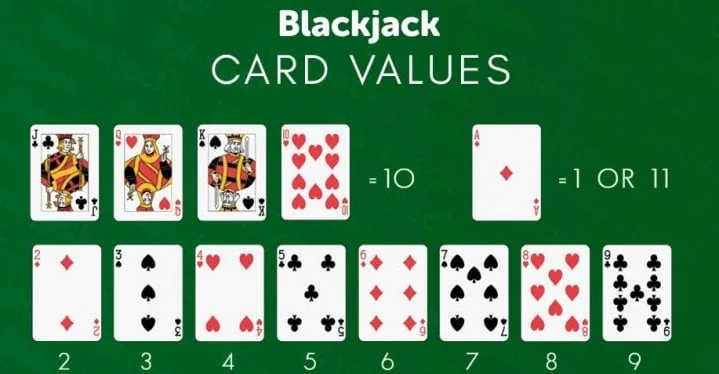
To build a total towards 21, first learn the value of each card. Numbered cards retain their face value: a three is worth 3 and a six is worth 6. Jacks, Queens and Kings are face cards and each count as 10. An Ace can count as 1 or 11, depending on the player’s choice and what the hand can support without exceeding 21.
For example, an Ace and a 7 can total 8 or 18, so you use the value that suits the hand. If you take a 4 next, the Ace changes to 1 automatically and the total becomes 7 1 4 = 12. Starting with an Ace is useful because a high subsequent card can be accommodated by valuing the Ace at 1. The tactical implications appear below.
Basic Blackjack Terminology
Several expressions recur throughout a blackjack round. The following list explains the terms you are most likely to hear:
- Hit – Requesting another card from the dealer.
- Stick / Stand – Keeping your current hand instead of taking another card.
- Bust – Taking a card that makes the hand total exceed 21.
- Push – Matching the dealer’s score, so the original stake is returned.
- Split – If the initial cards match, such as 2 6s or 2 Jacks, separating them creates two hands. Each receives another card and requires the relevant extra wager.
- Double Down – Doubling the original bet to receive one additional card.
- Surrender – Giving up the hand before playing it in return for 50% of the original bet.
- Soft hand – A hand whose total uses an Ace as 11.
- Blackjack – Making 21 with only two cards: an Ace and a face card or a 10. Blackjack usually pays 3:2.
For more terminology, consult our Blackjack Glossary and Terminology article.
Basic Blackjack Actions
Standard blackjack tables usually provide the following choices, with the available action depending on the situation in your hand:
- Hit: Choosing “hit” asks the dealer for another card. You may continue hitting while the hand remains at or below 21.
- Stand: When you "stand," you end your turn with the hand you currently hold and receive no further cards. This is generally chosen when your total seems strong enough to challenge the dealer or when another card might take you over 21.
- Double Down: With “double down,” you double the initial bet and take one additional card. It is normally considered when the hand appears likely to win and increasing the stake could improve the potential return.
- Split: “Split” separates a pair into two hands, each with its own additional bet. It may be used with cards of the same rank or with a pair that could produce strong hands. Rules for eligible pairs and the number of permitted splits vary by blackjack variant.
- Surrender: When you “surrender”, you give up the hand and receive half the original bet back. Depending on the blackjack variant, surrender may be early or late. It is generally considered when the hand has a low chance of winning and limiting the loss is preferable.
How a Blackjack Hand Plays Out
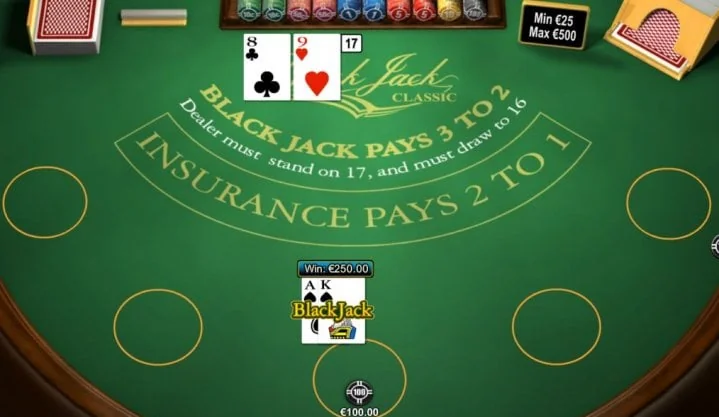
After players place their original wager in the betting box or betting circle, the dealer deals two cards to each player, faces down. The dealer also receives two cards, with one face-up. A player wins by finishing higher than the dealer without exceeding 21. After viewing their cards, players may hit, stand or surrender. Turns move from left to right around the table, and the dealer acts only after everyone has played. The contest is against the dealer, not the other players.
Early surrender means conceding before taking any extra cards. When available and used, it returns half of the original bet.
Players may take additional cards until reaching 21, going over it and losing automatically, or choosing to stand. Once all player turns end, the dealer exposes the second card and follows the table rules. Under the “17” rule, the dealer cannot draw again after reaching 17, while a total of 16 or under requires another card. This fixed procedure leaves the dealer less flexibility than the player.
When the dealer finishes, the hands are compared and winning players receive their payouts. A matching total is a draw called a push, and the original stake is returned.
Hard vs. Soft Hand Rules
Before joining an online or land-based blackjack table, check whether its dealer rules are hard or soft. “S17” and “H17” describe two different procedures for a dealer holding a soft 17, meaning a hand containing an Ace valued at 11. These rules can affect both the house edge and the decisions players make. Here is how the two options work:
S17 (Stand on Soft 17)
At a table using the S17 rule:
The dealer stands on a soft 17. In other words, when the dealer holds an Ace plus cards valued at 6, such as Ace-6 or Ace-2-4, they do not draw and instead stand on the total of 17.
This rule favours players because a dealer with a weak initial hand has a greater chance of busting, meaning going beyond 21. It also allows players to make more cautious choices after considering the dealer's upcard.
H17 (Hit on Soft 17)
At a table using the H17 rule:
The dealer must hit on a soft 17. Therefore, if the dealer holds an Ace and cards valued at 6, another card is taken.
This rule is less favourable to players because the dealer receives an extra opportunity to improve the hand. It reduces the chance of the dealer busting from a weak starting hand.
Note: S17 tables are generally considered more player-friendly because the dealer stands on a soft total, which can make a bust more likely. H17 rules give the dealer another opportunity to improve the hand. Before playing blackjack online or in a casino, check which rule applies, since it can affect both strategy and winning odds. Many players favour S17 for its slightly better odds, but your strategy should still match the rule in effect.
Number of Decks of Cards Used
The number of decks is another table feature to check alongside hard and soft rules. Deck count can influence the house edge and may affect strategy. Generally, fewer decks give the player more favourable odds.
- Single Deck Game: A table using one deck has the lowest house edge and is easier for anyone considering card counting. To balance those advantages, single-deck games often impose stricter conditions, such as limiting when doubling down or splitting is allowed.
- Double Deck Game: Double-deck games occasionally appear at online casinos. They can offer more favourable odds than multiple-deck tables, while their rules may be more liberal than those of single-deck games.
- Multiple Deck Game: Multiple decks are standard at many blackjack tables. Usually, four to eight decks are shuffled together. Casinos often favour this format because it makes card counting more difficult and also increases the house edge.
Players often have little choice over the number of decks. Online casinos, land-based establishments in Las Vegas and other major gambling destinations commonly offer multiple-deck games with four or more decks. If you do find a single- or double-deck table,
Blackjack Insurance Bets
Insurance is an optional side bet offered when the dealer’s upcard is an Ace. It pays 2-1 if the dealer has blackjack, consisting of an Ace and a 10-point card. The insurance wager is usually limited to half of the player’s original bet.
For instance, with an original bet of $10, the insurance wager would be $5. If the dealer has blackjack, the original $10 bet loses but the insurance bet wins $10, leaving a net loss of $5. If the dealer does not have blackjack, the insurance wager loses while the player can still continue playing the original hand.
Insurance is intended to protect the original wager from the dealer having blackjack. However, the odds generally do not favour the player, so taking insurance is usually discouraged. It is a negative-expectation bet: over the long term, a player taking it is expected to lose more often than win.
Splitting Blackjack Hands
Splitting is available when the starting hand meets the table’s conditions. It turns the original cards into two separate hands, but each new hand requires its own wager, increasing the total stake. Because splitting rules differ between blackjack variants, check them before playing.
- Splitting Tens: Jacks, queens, kings and 10s all count as ten points. Many online casinos permit these cards to be split, although some require matching ranks, such as two kings or 10s, rather than a king paired with a 10.
- Resplitting: This permits a pair to be split again, commonly no more than three times per hand. Other variants may allow one split, six splits or unlimited splits. For example, a player might resplit a pair of 8s and split again if another eight arrives as the second card in one split hand.
- Resplitting Aces: This uncommon rule is generally associated with Late Surrender games.
- Additional Draw after Splitting Aces: Usually, splitting aces allows only one drawn card for each Ace. Some variants remove that restriction and let players continue drawing.
- No Split Aces: This rare condition prohibits splitting aces. If it applies, avoiding that blackjack variant may be preferable.
- Split Anytime: Under this rule, a player may split after hitting. For example, if dealt 10, 2 and then another 2 after hitting, the deuces can be separated into different hands.
- Split any 16: This permits splitting any combination totalling 16, regardless of the individual cards, including 10 and 6, Ace and 5, or 9 and 7.
- No Splits on 4, 5 or Ten: This rule is used in UK casinos.
- Discard Split Hand: This uncommon but useful rule lets a player discard one of the hands created by a split.
Doubling Down
Doubling down lets a player double the initial bet in exchange for one more card. The decision is available only after the initial two cards arrive and before any further card is taken. It is intended to increase the possible payout on a strong hand or improve a hand that may beat the dealer.
The benefit is the opportunity to win more on a hand that appears strong. It can also increase the return from a hand that seems to have a good chance of winning.
The drawback is that doubling also increases the risk of busting, going over 21 and losing the entire bet. The move can be costly when the hand is weaker than expected.
Consider the dealer’s upcard before doubling down. Generally, doubling with a hand value of 10 or 11 is considered useful when the dealer shows a low card, such as 2-6.
Blackjack Tips and Tricks
Blackjack still involves substantial chance. You cannot control the cards dealt to you or the dealer, and software games do not allow card counting. You can, however, make more informed decisions and manage your play. Here are 10 suggestions to consider.
- Practice for free: Use an online casino’s practice mode to develop familiarity before risking your own money.
- Use a strategy chart: Keep a basic blackjack strategy chart available online so you can check the recommended decision.
- Set a budget: Choose your blackjack session budget in advance and do not exceed it.
- Choose the right table: Look for tables where the minimum bet is no more than 5% of your budget.
- Follow basic strategy: Hit hands below 17 when the dealer shows 8, 9, 10 or a face card, and stand on hands above 11 when the dealer shows 4, 5 or 6.
- Avoid insurance bets: Insurance against the dealer making blackjack is widely regarded as a “sucker’s bet” and is generally best avoided.
- Take advantage of doubling down: Double down with a ten-value card when the dealer shows nine or lower, and with any hand totalling eleven.
- Know when to split: With two cards of equal value, split by matching the original bet. Avoid splitting 10s or 5s, but split 7s or 8s when the dealer has a lower-value hand.
- Use progressive betting: Some players raise bets during a winning streak and reduce them during a losing streak, but this does not change the underlying odds.
- Opt for live dealer games: Live dealer games let you observe the table more closely and may permit card counting, unlike casino software games. Casino rules and policies still apply.
Using Blackjack Basic Strategy
For the best chance of making sound decisions during blackjack sessions, use a basic strategy. These guidelines match your cards with the dealer’s upcard to identify the mathematically preferred action. Players commonly use a blackjack strategy chart for each situation. Following one can reduce the casino advantage, but it cannot remove the house edge or guarantee a win.
Your hand and the dealer’s exposed card determine whether the appropriate action is to hit, stand, double down, split or surrender.
Basic strategy has many details, so our Blackjack Strategy Charts article provides a fuller explanation of how to play blackjack efficiently. Its core principles include:
- Always hit with a hand valued at 12 or lower.
- Always stand on a total of 17 or higher.
- When your total is between 13 and 16, take the dealer’s upcard into account.
- Stand in that range when the dealer shows 2 through 6.
- Conversely, hit when the dealer’s upcard is 7 through Ace.
There are further decisions for doubling down, which doubles the bet, and splitting pairs, where two cards of equal value and type become separate hands. Review the complete basic strategy to understand when each action is recommended.
Pros and Cons of Blackjack
Blackjack, like every casino game, has advantages and disadvantages. In our assessment, its benefits can compare favourably with those of other table games. Skill does not decide every result, but informed decisions can help reduce avoidable losses.
The Pros of Playing Blackjack
Playing blackjack can offer the following advantages:
- Low House Edge: With appropriate strategy, blackjack is known for having one of the lower house edges among casino games. Skilled players may reduce the edge to less than 1%, making the game comparatively favourable, though not risk-free.
- Skill-Based Game: Unlike games driven mostly by luck, blackjack gives players decisions that matter. Learning and applying basic strategy can improve the mathematical odds.
- Variety of Variations: Traditional and online casinos offer many blackjack variations. Players can compare versions and choose rules, formats and odds that suit their preferences.
- Social Aspect: Land-based blackjack is often played with other people at the table, creating an interactive atmosphere. Many online versions also provide a chatroom that contributes to the table experience.
- Potential for Profit: Skilled players using strategy and card counting may profit under favourable conditions, but profit is not guaranteed. Blackjack’s relatively low house advantage is why professional gamblers may consider it, not proof of a reliable income.
The Cons of Playing Blackjack
Even a player who understands blackjack well should consider these drawbacks:
- House Rules: Rules differ between casinos, and small changes can affect both the house edge and the correct strategy. Players need to adjust to the specific table conditions.
- Card Counting Difficulty: Card counting can be effective in some circumstances, but learning and applying it is difficult. Casinos also use countermeasures to identify and discourage the practice.
- Emotional Stress: Losing streaks and poor decisions can make blackjack emotionally demanding. Discipline and control over your reactions remain important.
- House Advantage: Even with a low house edge, the casino retains a long-term advantage. Over time, players are expected to lose more than they win.
How to Get Started Playing Blackjack

Many online casinos provide blackjack for new players, experienced users and high rollers. Beginners can look for low stakes and a high welcome bonus, while free blackjack games offer a way to practise before wagering real money. This can be a sensible introduction to the game.
Splitting, doubling down, surrendering and using the Ace add rules to learn, but the basic blackjack format is straightforward. That makes the game accessible to people new to online gambling. Learn the rules first, practise responsibly and decide whether it suits you.
Different Variations of Blackjack Table Games Online

Online blackjack offers a broad selection of variations compared with a brick-and-mortar casino. Tables commonly present standard formats across different betting limits, including games using both S17 and H17 rules.
Online casino software and live suppliers can create formats that may not be available at land-based casinos. These versions introduce different features while retaining the central blackjack structure. Once you understand standard blackjack, the changes in many variations are easier to follow.
Examples of blackjack games available at online casinos include:
- All Bets Blackjack (Playtech Live): This format suits players interested in side bets. It uses eight decks and offers seven side bets that can be placed separately from the main hand. Each side bet has its own RTP, and the house advantage is higher on a side bet than on the main game.
- Infinite Blackjack (Evolution): This live casino format uses unlimited-seat technology, so players do not queue for a seat as they might at 7-seat blackjack tables. Everyone plays the same hand dealt by the dealer. The trade-off is that cards dealt to other players do not provide useful information. Infinite Blackjack also offers four side bets.
- Blackjack Switch: This variation lets players exchange cards between two hands. Each player plays two hands in the same round and may “switch” the top cards. The extra feature comes with different rules: a dealer total of 22 pushes all non-busted hands, and a “Blackjack” pays 1:1 rather than 3:2.
- Free Bet Blackjack (Evolution): This live format provides free bets for certain doubles and splits. Doubling is available when the first two cards total 9, 10 or 11, and an additional free split may be available after a previous split produces another pair. If the dealer’s hand totals 22, it is a push, which offsets those free bets.
- Random Multiplier Blackjack Games (Multiple): Several live casino suppliers offer games with random multipliers, including Lightning Blackjack (Evolution) and Quantum Blackjack (Playtech Live). Lightning Blackjack includes a side bet paying 2x to 25x the stake after two consecutive winning hands. Quantum Blackjack uses three random cards with a 10x multiplier value that can stack for a larger bonus payout.
- These are only some of the blackjack variations available online.
Start Playing Blackjack Casino Games Online Today

Once you understand how blackjack works, you may want to try the casino table game yourself. The appeal comes from placing chips and hoping to build a hand that beats the dealer without busting.
GCCans can help you explore online casinos that offer play blackjack online. Many casinos provide both RNG, or random number generator, and live formats. To compare platforms, review our top-rated casino reviews and assess the relevant terms before playing.